AV ERIK SANDBERG
Textil- och modeindustrin är en av världens mest miljöpåverkande industrier och den behöver därför utvecklas till att bli mer hållbar. Cirkulära flöden av använda, begagnade textilier är en viktig del av denna utveckling och där spelar en välfungerande, effektiv logistik en avgörande roll.
Cirkulära materialflöden av använda textilier innefattar typiskt aktiviteter såsom insamling, sortering, lagring, transporter, återvinning och försäljning. De organiseras och styrs idag av ett stort antal olika aktörer, däribland detaljhandelsföretag, second hand- och sorteringsföretag. Ur ett svenskt perspek tiv är ofta välgörenhetsorganisationer tongivande, men det finns även gott om kommersiella spelare som medverkar i dessa flöden. Tillsammans utgör de ett komplext nationellt såväl som internationellt ekosystem av aktörer som får en allt större betydelse i takt med att efterfrågan på hållbara material och produkter ökar. Även skärpta lagar kring producentansvar av textilier som just nu utreds i Sverige och övriga EU gör att detta ekosystem blir allt viktigare.
Det cirkulära ekosystemet
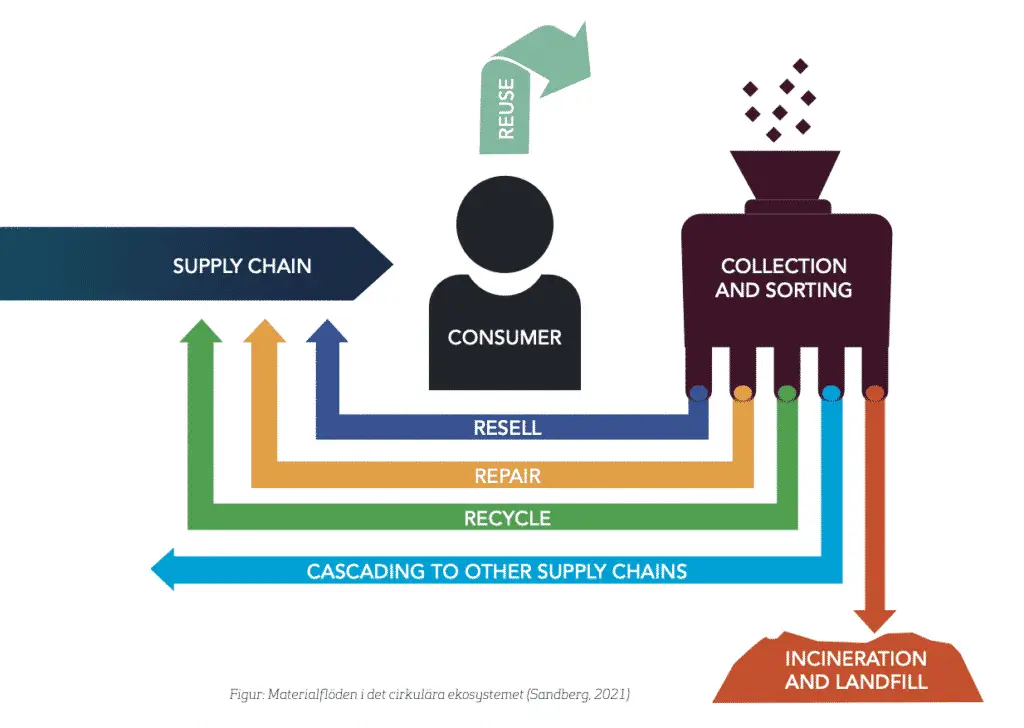
På ett övergripande plan kan det cirkulära ekosystemet beskrivas med ett antal flöden som på engelska brukar benämnas reuse, resell, repair och recycle, se figuren. Insamlade textilier kan också ingå som råmaterial till helt andra typer av verksamheter, exempelvis vid tillverkning av trasor eller som utfyllnadsmaterial (på engelska kallas denna övergång från det ursprungliga användningsområdet till en annan kedja för ”cascading”). En sista utväg för att undvika deponi kan vara att förbränna textilierna för att på så sätt åtminstone utvinna dess energi.
Reuse, resell och repair
Vad gäller livsförlängande flöden (typiskt reuse, resell och repair) spelar den alltmer omfattande och mångfacetterade secondhandförsäljningen en avgörande roll. Här finns idag i Sverige ett stort utbud av såväl fysiska butiker som online-butiker som inte enbart bygger på ett klassiskt lågpriserbjudande, utan också mer högprofilerade, nischade verksamheter som bygger på unikhet och hållbarhetsimage. Det finns också olika typer av marknadsplatser såsom Sellpy, Tradera och Blocket för direktförsäljning mellan konsumenter. Utöver secondhandförsäljningen har också många andra cirkulära affärsmodeller utvecklats senaste åren, däribland uthyrning, reparations- och lagningstjänster. Denna breddning av cirkulära affärsmodeller innebär att många nya kundgrupper har fångats, och volymerna att hantera i dessa flöden stiger stadigt – om än från relativt låga nivåer.
Lite som återvinns
Majoriteten av de textilier som samlas in bedöms i slutänden inte ha en potential för livsförlängande åtgärder, och går därmed till andra användningsområden (såsom trasor eller utfyllnadsmaterial) eller blir föremål för förbränning eller deponi, antingen här i Sverige eller i andra länder. För att minska dessa andelar finns idag flera tekniker för återvinning av textilfibrer (recycling), dock är de totala volymerna
i dessa flöden fortfarande små. Enligt en rapport från Ellen MacArthur Foundation (2017) är det idag mindre än 1 procent av de insamlade textilierna som återvinns globalt (i Norden är siffran något högre, ca 2 procent, enligt Roos et al., 2019). Fiberåtervinningen kan i princip ske på två sätt; mekanisk respektive kemisk fiberåtervinning. Mekanisk återvinning, där textilierna klipps och rivs ner för att sedan spinnas till nytt garn, är idag den mest utbredda och gångbara tekniken. Den är relativt enkel men innebär en försvagning av materialet, vilket betyder att återvunna fiber behöver blandas med förhållandevis höga andelar av nyproducerat material. Kemisk återvinning anses vara lovande då denna teknik inte skadar fibrerna på samma sätt. Men även om teknikutvecklingen de senaste åren gjort stora framsteg är kemisk återvinning fortfarande ovanlig i kommersiell skala. Ett undantag är det svenska företaget Renewcell, vars verksamhet bygger på fiberåtervinning av framför allt bomull.
Klassiska logistikutmaningar i en ny kontext
Utifrån ett logistiskt perspektiv innebär dessa cirkulära flöden många klassiska logistikutmaningar men i en ny kontext. Typiska logistiska ledstjärnor såsom behovet av systemsyn, skal- och stordriftsfördelar, samt processorientering är avgörande, precis som i de ”vanliga”, linjära flödena. Annars finns en uppenbar risk att de cirkulära flödena framöver kommer att bli mycket kostsamma i takt med att volymerna som ska hanteras i dem ökar, samtidigt som chanserna till ett optimalt värdeskapande går förlorade. Likaså kan det skapas cirkulära flöden som är betydligt mindre miljömässigt hållbara än vad som är tanken. Utmaningen vi logistiker har framöver är att bidra med vår kunskap och stå upp för logistikens roll och betydelse i framtidens utformning av cirkulära affärsmodeller, strategiska samarbeten, användning av ny teknik, etc. Detta är en av de övergripande insikterna från det pågående forskningsprojektet ”Dynamiska förmågor i handelns logistiksystem” som finansieras av Handelsrådet där forskare från Linköpings universitet och medarbetare på H&M medverkar.
Logistikutmaningar i cirkulära flöden
Några exempel på logistikutmaningar inom cirkulära flöden som blir allt tydligare ju mer volymerna ökar är följande:
Kundorienterad insamling: I takt med att efterfrågan på cirkularitet och miljömässigt hållbara alternativ ökar kommer efterfrågan på återvunnet råmaterial, dvs. insamlade textilier, att öka, och det blir därmed allt viktigare att kunna tillförskansa sig denna råvara. Här finns idag en stor potential, då mer än hälften av de textilier som konsumeras varje år i Sverige slängs bland hushållssoporna. Vi har länge pratat om ”convenience” i kundernas köpprocesser som en stark trend och nu är det läge att fortsätta se över hur denna bekvämlighet kan ut- vecklas vad gäller donation och insamling. På samma sätt som logistiker inom exempelvis e-handeln har varit framgångsrika på att skapa kundanpassade, flexibla leveransalternativ behöver vi nu kunna skapa en palett av olika insamlingsmöjligheter som tillfredsställer kundernas önskemål. Denna resa är förstås redan påbörjad, och inspiration finns att hämta från exempelvis Sellpy som skickar ut och erbjuder upphämtning av påsar med använda kläder i konsumenternas hem. Olika mobila insamlingskampanjer, samordning med e-handelsleveranser, och överhuvudtaget mer kundnära uppsamlingsplatser är andra viktiga inslag.
Kostnadseffektiva logistikflöden: I takt med att volymerna stiger i de cirkulära flödena blir det också allt viktigare med kostnadseffektivitet, speciellt med tanke på att det redan idag råder en tuff konkurrenssituation där nyproducerade material och arbetskostnader i samband med den linjära produktionen är oerhört låga. Och även om ett ökat intresse för hållbarhet kan komma att påverka priserna på exempelvis secondhandkläder i positiv riktning, kommer kostnader för hantering, transport och lagring framgent spela en avgörande roll för att kunna skapa lönsamhet i de cirkulära flödena. Lokala flöden behöver samordnas med komplexa globala ekosystem för att maximera värdet från de insamlade textilierna och för det behövs en välfungerande logistikapparat. Ytterligare en svår nöt att knäcka är det faktum att många cirkulära affärsmodeller bgger på hantering och lagerhållning av unika produkter (t.ex. prissättning eller fotografering inför en online-försäljning), vilket försvårar standardiserade processer som bidrar till stordriftsfördelar och kostnadseffektivitet.
Användning av digitala hjälpmedel och ny teknik: Ett sätt att kunna skapa kostnadseffektivitet är att utnyttja ny teknik, exempelvis genom mer automation, vilket inte minst är viktigt för länder i västvärlden. Framför allt ser vi detta i den enormt arbetsintensiva sorteringen av textilier i recyclingflödet. Ny teknik möjliggör att denna sortering idag kan ske helt automatiserat. Redan idag finns i Sverige en kommersiell aktör, Sysav, som i sin anläggning (SIPTEX) använder sig av nära-infraröd och visuell spektroskopi (NIR/VIS) för att sortera textilier efter fibertyp och färg. Sorteringsanläggningen möjliggör en hantering i ett högkostnadsland som Sverige, vilket innebär stora besparingar i exempelvis transportkostnader. Användning av exempelvis AI i sorteringen är ett annat område som är på frammarsch. AI kan här användas för att mer precist kunna identifiera plagg som har potential att återförsäljas. På så sätt kan mer värde extraheras av de insamlade kläderna samtidigt som plagg som inte kan säljas minimeras.
Skapa jämna, förutsägbara materialflöden: En ökad grad av automation i form av t.ex. sorteringsanläggningar innebär dock nya typer av logistikutmaningar. En storskalig automatiserad sortering har flera likheter med en processindustri där ett jämnt och förutsägbart inflöde av material är viktigt för att säkerställa en jämn ”produktion” och utnyttjandegrad av maskiner. En storskalig sortering i olika fraktioner tydliggör också behovet av design och utformning av hela den efterföljande försörjningskedjan. För att undvika förbränning eller deponi behöver utbudet i de olika fraktionerna matchas ihop med efterfrågan hos olika intressenter. Detta kräver att nya aktörer blandas in i kedjorna som mellanhänder, både lokalt och globalt. Generellt innebär detta att kraven på en adekvat lagerhållning, prognostisering och informationsdelning genom hela kedjan ökar ytterligare.
Systemanalyser: Ytterligare en logistikrelaterad utmaning, exempelvis i samband med introduktion av nya cirkulära affärsmodeller, är att kunna göra en systemanalys för att säkerställa att de kostnader och miljöpåverkan som uppstår i samband med transporter och hantering inte överstiger dess nytta. En grundfråga som ställs allt oftare är huruvida olika cirkulära affärsmodeller verkligen är miljömässigt ”bra”. Vilken energiåtgång eller koldioxidutsläpp orsakas av exempelvis uthyrning av kläder, som kräver flertalet transporter och tvättar? En finsk studie från förra året (Levänen et al., 2021) påvisade att i fallet med jeans kan en ökning av plaggets användning från 200 ggr till 400 ggr ge en avsevärt bättre miljöpåverkan. Men om denna ökning sker genom exempelvis uthyrning, där jeansen behöver distribueras mellan olika användare, kan den totala miljöbelastningen bli större än nyttan om konsumenten exempelvis använder sig av bil för att hämta upp plagget. Generellt är det också viktigt att den cirkulära affärsmodellen, t.ex. uthyrning, verkligen ersätter en linjär konsumtion och att det inte enbart fungerar som en tilläggstjänst. Utöver miljöpåverkan kan också de totala logistikkostnaderna behöva analyseras mer noggrant. Generellt tenderar många systemanalyser idag att bortse från många av de logistikaktiviteter som uppstår i de cirkulära materialflödena, och det är därför viktigt att tillföra ett logistikperspektiv vid genomförandet av denna typ av analyser.
Till sist
Logistiken behöver ta på sig ledartröjan och på ett lika självklart sätt som man styr sina linjära flöden också styra de cirkulära. För att detta ska ske behöver roll- och ansvarsfördelning ses över i många organisationer, och incitament och engagemang skapas. Mer kunskap krävs också kring dessa frågor och på Linköpings universitet kommer vi därför under våren 2022 påbörja det FORMAS-finansierade projektet ”Logistikens roll i det textila cirkulära ekosystemet” i samarbete med Textilhögskolan i Borås och H&M. Framförallt kommer projektet utveckla ny kunskap om hur logistiska resurser och förmågor ska kunna orkestreras i ett cirkulärt ekosystem samt vilket eller vilka värden som logistiken egentligen bidrar till att skapa i dessa. Här ingår förutom ekonomiska värden också andra typer, såsom image-, informations-och miljömässiga värden. Vi hoppas förstås kunna återkomma till läsarna av Supply Chain Effect med resultat från detta projekt.
Erik Sandberg är biträdande professor i Logistics Management på Linköpings universitet.