BY HENRIK GILLSTRÖM, MAGNUS BLINGE, MARIA HUGE-BRODIN, SABRINA BRUNNER, JORGE GUTIERREZ CHIRIBOGA, MY JOBRANT, AND UNI SALLNÄS
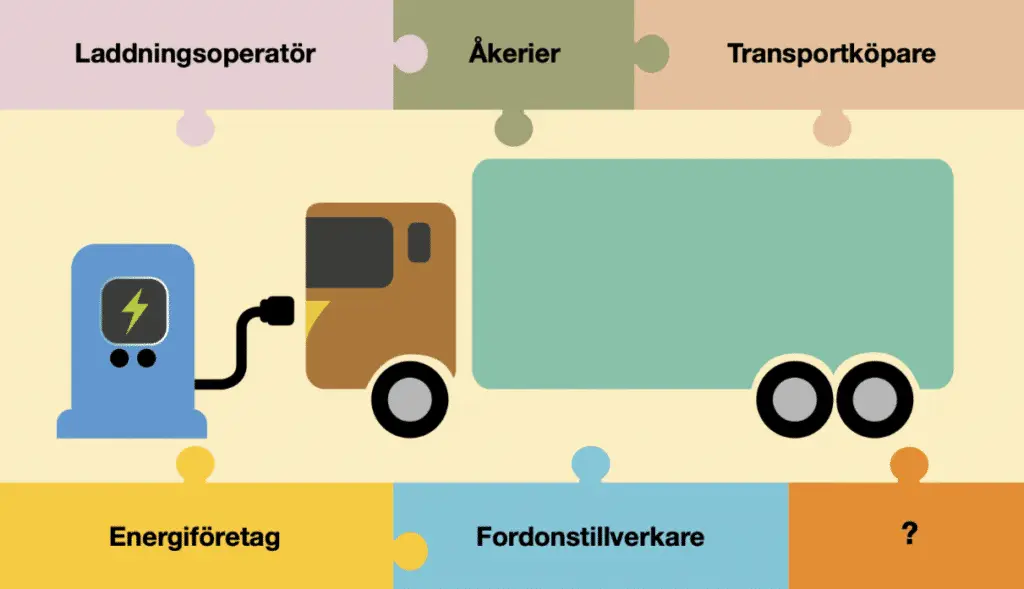
The electrification of road transport is a crucial component of the transition to a climate-neutral society. This transition affects not only the technology but the entire ecosystem of stakeholders. This article, based on research from the Department of Logistics and Quality Development at Linköping University, highlights the effects of electrification from a systems perspective—with a focus on the relationships between stakeholders, trucking companies, transport buyers, charging operators, and vehicle manufacturers.
Electrification is not a one-size-fits-all solution, but rather a spectrum of technologies that are being developed in parallel: battery-electric trucks, electric roads, hydrogen-powered engines, fuel cells, and battery swapping. These technologies are likely to coexist in various configurations depending on regional conditions such as energy availability, infrastructure maturity, and economic viability. In Europe, the trend points toward battery-electric trucks becoming dominant, but alternative solutions may be crucial for long-haul transport and areas with limited grid capacity, where biofuels also represent a possible alternative. In this article, however, we focus primarily on battery-electric trucks.
Electrification Technologies and Their Impact on Systems
The choice of technology affects the entire logistics system—from how supply chains are designed to which actors gain influence. New players such as energy companies, charging operators, and digital infrastructure operators are entering the transportation system, which requires new forms of coordination and governance. Electrification is thus not merely a technical transition, but a socio-technical transformation that requires the integration of technical, institutional, and economic dimensions.
Ecosystem of Stakeholders
To understand the full impact of electrification, we must look beyond the technology itself and focus on the broader ecosystem of stakeholders who, together, will shape the transportation system of the future. Electrification entails not only new technical solutions, but also changing roles, relationships, and divisions of responsibility. Freight carriers face major investments and operational challenges; transportation buyers are redefining their role from passive customers to active enablers; and charging providers are emerging as a strategic component of the infrastructure. Vehicle manufacturers are in the midst of a comprehensive technological shift and play a key role in developing and making electric vehicles available. In the following text, we delve deeper into these perspectives to highlight how electrification is reshaping logistics practices and interactions.
Relationships as the Key to Building Knowledge
Relationships between actors in the logistics system are always important. Research conducted across a wide range of projects has shown that it is precisely through interaction between actors that various sustainability solutions gain traction and funding can flourish and spread further. This is particularly significant in the context of electrification, for several reasons, where complexity and uncertainty are central. The electrification of logistics systems means that interaction is needed with more stakeholders than is traditionally the case. The role of vehicle manufacturers is becoming increasingly important, and logistics companies that build close relationships with vehicle manufacturers both gain and contribute knowledge about the new technology and its application. Stakeholders in the electricity supply and charging sectors, in turn, are examples of new players who, with traditional solutions, ”have simply always been there” (gas stations). Relationships with these players are added to the usual set of relationships. At the same time, existing relationships cannot be replaced overnight, as vehicle fleets are phased out gradually and relationships with suppliers of various technologies and energy sources must be managed simultaneously.
Cooperation and Trust Are Key
The uncertainty surrounding this development relates to both content and timing. Uncertainty regarding content means that it is unclear which technology (battery-electric trucks, hydrogen, conventional, biogas, or other) should be prioritized, and in terms of timing, the development is very difficult to predict. When key players work together, the chances of managing these uncertainties increase. Trust in each other’s expertise is central, and it is often built over time; successful logistics operators view this as an investment. Overall, a great deal of new knowledge needs to be developed, and here the relationships between logistics operators play a major role in gaining access to other operators’ knowledge and in creating the space to build new knowledge together. For trucking companies with limited resources, this is particularly challenging—the time and capacity to build relationships are limited. But relationships are also a path to knowledge, support, and collaborative problem-solving. The ability of logistics operators to build and maintain relationships will be crucial to the success of electrification—and, ultimately, to society’s ability to meet its climate goals.
Challenges and Opportunities for the Trucking Industry
For trucking companies, electrification poses a number of practical and financial challenges. Battery-electric trucks are expensive to purchase, especially the heavy-duty models, which makes leasing an attractive option. Although operating costs are lower, a high utilization rate—such as driving multiple shifts—is required for the investment to be profitable. In practice, this is difficult to achieve, especially for smaller trucking companies. Another challenge is the charging infrastructure. The lack of public charging stations for heavy-duty vehicles means that many hauliers are forced to invest in their own charging stations. This entails high initial costs but can also offer benefits such as lower energy costs and greater control over operations. At the same time, many trucking companies are small businesses with limited resources and low profit margins, making it difficult to shoulder these investments on their own. For electrification to become a reality, collaboration is essential—especially with transportation buyers, whose requirements, willingness to pay, and openness to change can create the conditions necessary for investment. Trucking centers, manufacturers, and other stakeholders are also important partners. Political stability and long-term support are crucial to giving the industry time to transition and spread the risks.
The Changing Role of the Transportation Buyer
Freight buyers have traditionally viewed transportation as a cost center—something that is outsourced to streamline operations. Electrification is changing this perspective. Purchasing transportation services using battery-electric trucks requires a greater commitment: installing charging infrastructure, adjusting operating hours and logistics flows, and accepting higher costs. Despite these challenges, interest is high. Many transportation buyers view electrification as key to achieving their sustainability goals and strengthening their brand. Research shows that improvements in the transportation sector are a crucial part of the green transition, and that this is driving new forms of collaboration with carriers and logistics providers. An intensive learning phase is underway, in which transportation buyers are once again engaging with transportation issues—not just as customers, but as co-creators of solutions. By taking an active role, they can help overcome the financial and operational barriers posed by electrification.
The Charging Ecosystem and the Charging Operator
Charging battery-electric trucks will become absolutely crucial, but there are important issues that need to be addressed, such as who will be responsible for ensuring that electricity is available where it’s needed. Although the charging operator plays a directly decisive role, this role has been relatively understudied. Research shows that this role is not tied to any specific actor but can be fulfilled by, for example, logistics companies, energy companies, fuel stations, or transportation buyers. This is partly because charging will need to take place at various locations (at terminals, destinations, and along the road network). Logistics companies install their own chargers to ensure operational reliability, but also see opportunities to offer public charging. Transportation buyers can offer charging at their facilities to facilitate electrification. Fuel stations and energy companies view charging as a way to expand their business. However, the challenges are significant: long lead times for grid connections, complex permitting processes, and the need for charger reservation systems. Creating a functional charging system requires collaboration among stakeholders and an understanding of the strategic importance of charging operators.
The automaker at the center of the technological shift
Vehicle manufacturers play a central role in the transition to electric freight transport. With their technical expertise and production capacity, they are crucial to developing and making available the vehicles needed for this transition. At the same time, they themselves are in the midst of a major technological shift, where electrification is placing new demands on product development, business models, and internal work processes. Heavy-duty battery-powered electric vehicles pose challenges for the entire transport chain. Vehicle manufacturers are actively working to address these challenges—technically, organizationally, and strategically—and have established new business units to market and sell electric vehicles. By participating in pilot projects and system initiatives—often in collaboration with trucking companies, logistics firms, and transport buyers—vehicle manufacturers contribute to knowledge building and market development. These projects, which can be both market-driven and publicly funded, serve as platforms for testing solutions, building expertise, and creating the conditions for broader electrification. Beyond technological development, the challenge for vehicle manufacturers lies in establishing new internal processes and system support capable of handling the increased complexity. Electrification requires new skills and a changed way of working—a transition that, in itself, has far-reaching consequences for the entire organization.
Concluding Reflection – Collaboration as a Driving Force in the Electrification Ecosystem
The electrification of road transport is not an isolated technical change, but a comprehensive transformation that requires stakeholders throughout the entire logistics system to act in concert. The logistics system also includes several stakeholders who traditionally have not played a prominent role in logistics systems, such as vehicle manufacturers and charging operators. By understanding and developing both existing and new relationships, sharing knowledge, and taking joint responsibility for investments and infrastructure, the sector can navigate the complexity and uncertainties that come with the transition. It is through collaboration among key players that electrification can become both practically feasible and strategically sustainable.
……..
All of the authors are employed, either full-time or part-time, at Linköping University. Henrik Gillström is a senior lecturer in environmental logistics, Magnus Blinge is an adjunct professor, Maria Huge-Brodin is a professor of environmental logistics, Sabrina Brunner is a doctoral student in logistics, Jorge Gutierrez Chiriboga is an industrial doctoral student in logistics, My Jobrant is a doctoral student in logistics, and Uni Sallnäs is an associate professor of environmental logistics.