
Two years ago, Einride’s financial situation was dire, and the company was on the brink of bankruptcy. Its coffers were empty and needed to be replenished quickly. On Wednesday, Einride was fast-tracked onto the Nasdaq in New York via a so-called SPAC (Special Purpose Acquisition Company) process, which means it merged with a previously listed shell company instead of conducting a traditional initial public offering.
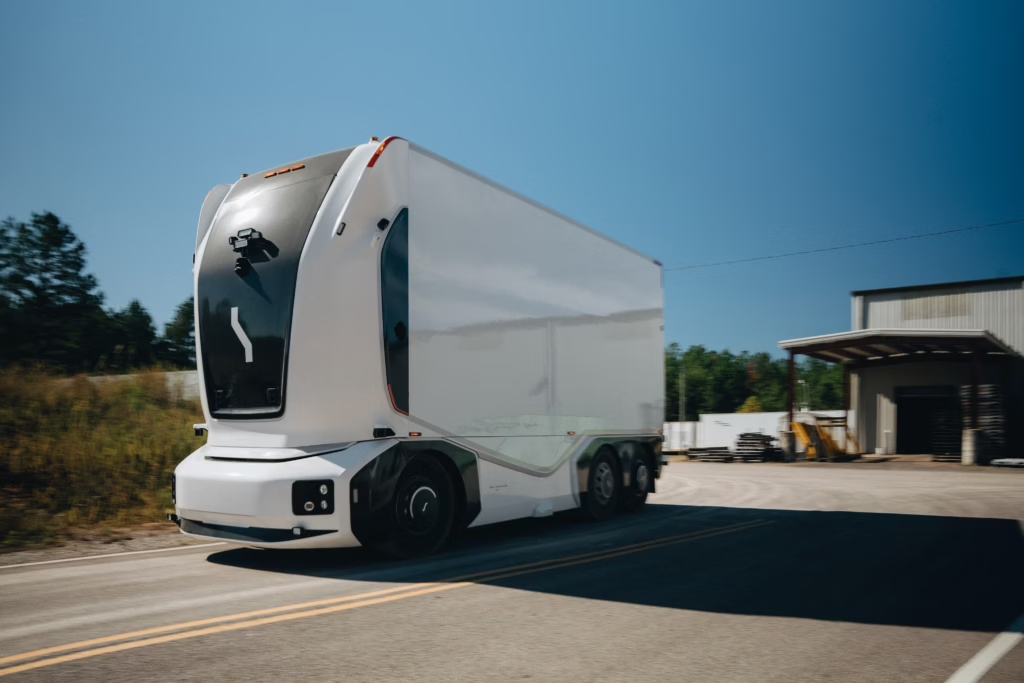
Einride was founded ten years ago by Robert Falck, Linnéa Kornehed, and Filip Lilja. From the start, the business idea was seen as quite ambitious. The company wanted to transform the freight transport industry by combining software, AI, and electric autonomous vehicles. Perhaps time has now caught up with the company? Today, Einride is a transportation and tech company that sells electric freight transport as a service—”freight-as-a-service.” Alongside this service, the self-driving truck T-pod, launched in 2017, has continued to evolve under the name Einride Pod. The same applies to the in-house developed transport platform Saga, which was launched in 2020. Saga AI, which analyzes, plans, optimizes, and controls the electrified transport operations, is being gradually developed and equipped with increasingly advanced AI capabilities.
Losses in the tens of billions
The cost of all development amounts to at least 5.4 billion, according to the latest annual financial statements. Over the years, the search for ”new money” has been intense. The 2024 crisis was managed through cost-cutting measures, layoffs, and suspended salary payments. The rescue came in the fall of 2025 when the company finally managed to close a funding round that raised 100 million USD (then 950 million SEK). The funds came primarily from existing core investors EQT Ventures and IonQ, as well as several new investors, including a major U.S. asset manager whose identity remains confidential.
The auditor issues a warning
In 2025, Einride had revenue of 458 million kronor, but still reported a loss of 1.7 billion. Speaking to Dagens Industri, the company’s CEO, Roozbeh Charli, says the plan moving forward is to build on its existing operations, grow alongside its customers, and continue to develop its technology. However, in the current listing prospectus, the company’s auditor warns that the company may not become profitable in the future and issues a warning regarding the company’s ability to survive.
Positive macro trends
But despite all the obvious risks, there are several overarching trends that suggest Einride may actually succeed. To begin with, there is a severe driver shortage in both Europe and the U.S., and that shortage is growing every day. This supports both autonomous vehicles and better, more efficient use of transportation capacity. Add to this the growing climate requirements and the need to reduce emissions from freight transport, which are driving both greater electrification and transportation optimization.
A Breakthrough for Autonomy?
In addition, autonomous transportation has moved from being just hype to finally becoming a reality. This is particularly true in the U.S.—which Einride views as its main market—where an increasing number of regulatory permits are being granted for autonomous freight transport. In the U.S., each state decides on its own regulations for autonomous freight transport. Some states have already approved fully autonomous commercial driving, while others currently allow only testing or require the presence of so-called safety drivers who either ride along in the vehicle or sit in a control center, ready to take over if necessary.
Been overtaken by the competition?
The fact that there are now better technical and regulatory conditions, as well as genuine market demand, thus works in Einride’s favor. The main risks are likely that the company won’t be able to scale up its operations quickly enough, that it will run out of money, or that it will be overtaken by major competitors such as Tesla, Volvo, and Daimler.






