Globally, the automation industry grew by 30 percent in 2021 and by 16.6 percent the following year, before declining slightly in 2023. However, the warehouse automation industry’s growth rate will quickly return to double digits, according to the British research firm Interact Analysis in its latest Warehouse Automation Report.
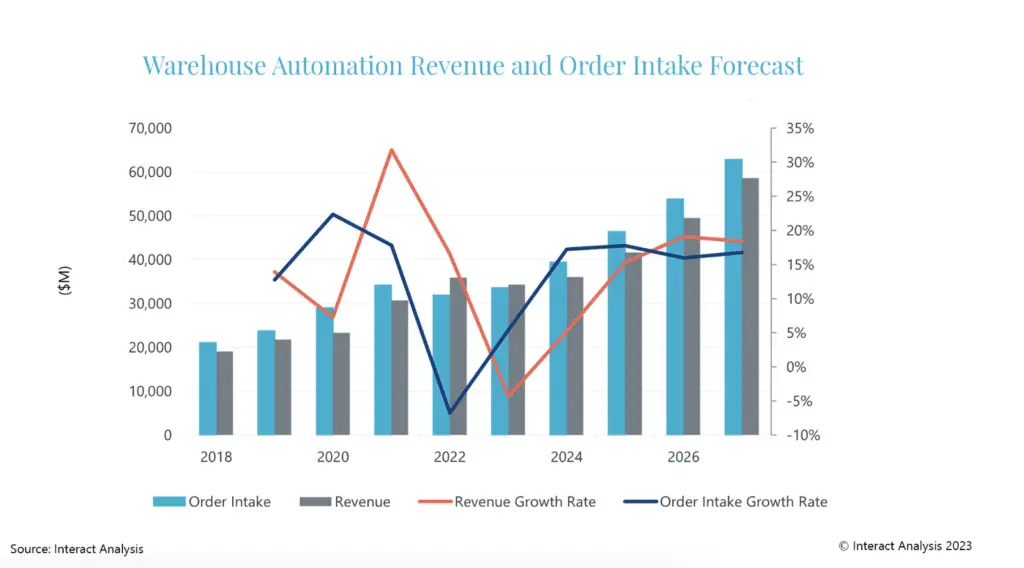
According to the mid-year update to Interact Analysis’ latest Warehouse Automation Report, order intake for warehouse automation will begin to rise toward the end of 2023 and continue to grow throughout 2024, returning to double-digit growth rates in 2025. This increase is closely linked to the expected rise in new warehouse construction.
– We’re seeing the first signs of light at the end of the tunnel for warehouse construction and automation investments as e-commerce activity begins to stabilize. After hitting rock bottom, the situation appears to be improving, and investments in warehouse automation are expected to increase in 2024 compared to this year and potentially return to double-digit growth in 2025, says Reuben Scriven, research director for Global Supply Chain Automation at Interact Analysis.
The research firm estimates that global revenue from warehouse automation will reach $51.4 billion by 2025, representing a 15 percent increase compared to estimated levels for 2024. This double-digit revenue growth is expected to follow a 7 percent increase in 2024 and a 1.6 percent decline in 2023.
Increased construction of new warehouses
Interact Analysis’ report indicates that warehouse construction will increase in 2024, following an estimated 25 percent year-over-year decline. Slowing growth in e-commerce and rising interest rates are cited as the main reasons for the decline in new warehouse construction. However, warehouse construction is expected to begin growing again starting in late 2023, which in turn will drive demand for automation solutions in 2024 and into 2025, particularly in the United States.
“Many companies are now taking increased unpredictability into account, and this is also affecting inventory buildup, as companies increase their inventory and therefore demand more storage capacity,” Scriven points out.
Demand for warehouse automation increased following the COVID-19 pandemic as e-commerce accelerated and the need for warehouse space grew, particularly in industries such as retail, manufacturing, logistics, and package delivery. However, global demand began to decline in 2022 due to the overcapacity built up during the pandemic, the slowdown in e-commerce, and the overall downturn in the global economy, according to Interact Analysis.