
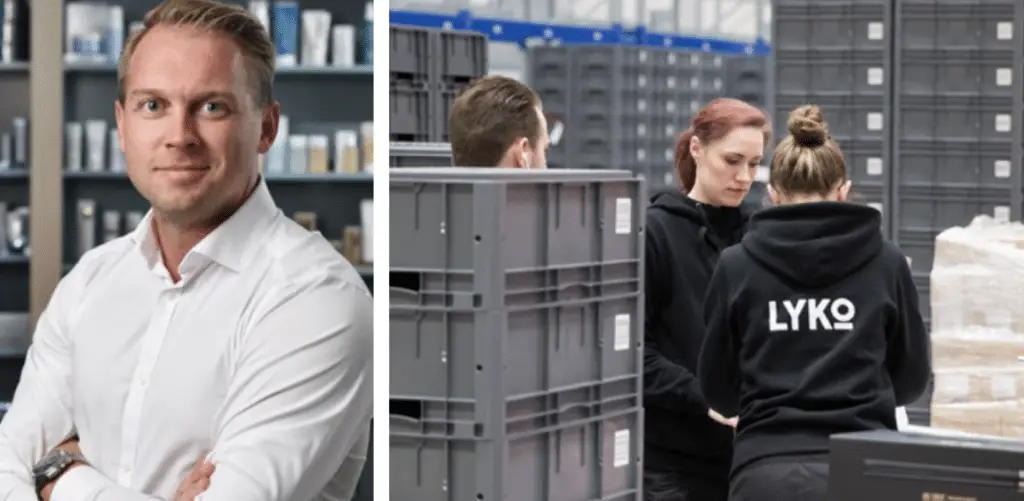
Lyko Group is not only a fast-growing retailer of hair and beauty products, but also a textbook example of a business where a strong focus on employee development and the work environment is combined with highly intensive and comprehensive warehouse automation.
– About a year ago, we signed an agreement with Vanderlande for an expanded automation solution at our central warehouse in Vansbro. “Once the facility is fully installed by the end of next year, we will have increased our order capacity from 40,000 to 100,000 orders per day,” says Peter Gunnarsson, who has served as Chief Technology Officer at Lyko since 2016—a role that, for the past few months, has also included responsibility for the strategically important logistics operations.
The roots of today’s Lyko lie in the men’s barbershop that Frans Lyko opened in Vansbro in 1952. Frans came to Sweden as a Polish refugee in 1945 after spending six years in a concentration camp. In 1971, his son, Stefan Lyko, opened the Hår & Skägg salon in the neighboring town of Dala-Järna, which later led to the launch of the online store lyko.se in 2003 as a complement to the hair salon. However, the online store grew very quickly, and since 2008, Frans Lyko’s grandson, Rickard Lyko, has been leading the expanding group.
“This is a key piece of the puzzle for achieving our long-term growth plan and for staying at the forefront in terms of both delivery and customer experience.” “We need to be forward-thinking and make decisions proactively, since infrastructure projects of this kind have long lead times,” says Rickard in a comment on the latest warehouse project—an investment totaling nearly half a billion kronor.
Technology That Enhances the Customer Experience
Heavy investment in technology is a crucial component of Lyko’s strategy and something that Rickard Lyko has strongly championed. As early as 2012, for example, the company invested in a packaging machine, a robot, and a conveyor belt to optimize packaging and thereby handle increased volumes while maintaining high-quality customer service. And since then, bold investments in technology have been a hallmark of the business.
– With the customer at the center, we want to streamline our processes and eliminate friction in the customer experience. We do this by continuously improving both our technology and our logistics operations. We’ve always had this strategy, but it’s only now that we’ve gained the financial resources that we’ve been able to make a major investment, explains Peter.
”The new warehouse was too small on day one”
In December 2017, Lykos’s stock was listed on Nasdaq First North Premier, which paved the way for continued investment in rapid growth. The following year, a decision was made to invest in a brand-new, automated warehouse in Vansbro with the aim of streamlining warehouse operations and enabling continued growth.
“It was a big deal when we moved into the new warehouse in February 2020. But a couple of weeks later, the pandemic hit, and demand skyrocketed. Even though we had planned for continued growth, no one could have foreseen the pandemic and its impact on e-commerce,” says Peter.
The surging demand prompted Lykos’s management to bring forward the planned Phase 2 of the new warehouse. This meant that the newly inaugurated shuttle solution was doubled in size, and a facility with 700,000 storage locations and 300 robots was able to begin operations as early as November 2021.
– That expansion gave us the capacity to handle 40,000 orders per day, even though we had never received more than 28,000 orders in a single day. We therefore believed that capacity would be sufficient for a while, even though we were planning a further expansion of our warehouse and even more automation.
100,000 orders per day
In 2019, Lykos’s revenue exceeded one billion kronor. And it soon became clear that 40,000 orders per day weren’t enough to meet the company’s goals. By 2021, the company’s revenue had already exceeded two billion, and by 2023, it surpassed three billion kronor in revenue. The need
The need for even more warehouse capacity became apparent, leading to the decision to increase order capacity in Vansbro by 250 percent.
“About a year ago, we signed an agreement with the automation company Vanderlande for an automation solution that gives us the capacity to handle 100,000 orders per day with much greater efficiency while maintaining flexibility,” says Peter, clearly proud and satisfied with the decision.
After a thorough procurement process, the choice ultimately fell on Vanderlande, a long-established company founded in Veghel, the Netherlands, in 1949, which has been a subsidiary of Toyota Industries Corporation (TICO) since 2017.
– Vanderlande was able to best meet the requirements of our RFQ, and they also offered a software solution that met our expectations, which was important. All in all, we got a solution that gives us the best efficiency and capacity for our money, and we also have a good cultural fit that makes it easy to communicate and solve problems together.
”Competent logistics partner”
Ever since the initial decision to automate was made in 2018, the Nordic logistics consulting firm Langebæk has served as an advisor and procurement support for Lyko.
“Our former logistics manager, Anna Persson, reached out to Langebæk because we knew virtually nothing about logistics automation. Over the years, we’ve had a great partnership, with Langebæk serving as a competent logistics partner that has supported us in various ways,” says Peter, specifically mentioning the consulting firm’s expertise and experience in managing complex warehouse projects and handling the important procurement and contracting processes that result from automation initiatives. Peter explains that the partnership has evolved as Lyko’s own staff has gained more knowledge and the ability to handle various logistics issues on their own.
– In the latest phases of our automation projects, we’ve been doing more and more on our own, and Langebæk’s role has become more overarching. They do an excellent job of helping us with overall project management and handling commercial matters with the automation suppliers.
Satellite warehouse for European expansion
With growing demand in Europe, Lyko has also begun to expand its logistics capabilities outside of Vansbro. To facilitate continued expansion in the company’s growing markets in Germany, the Netherlands, Poland, and Austria, a dedicated semi-automated logistics hub was recently established in Berlin. The new satellite warehouse was inaugurated in May 2023 and became operational just six months after the decision to establish it was made.
“For us, access to warehouse and logistics capacity is a strategic issue because it is essential for our continued growth, both here in the Nordic region and in our growing markets throughout the rest of Europe,” explains Peter, emphasizing that logistics must never become a constraint on development and growth.
Enhanced customer experience at a lower cost
The newly opened hub is tailored to the parts of Lykos' product line that sell best in Europe. Other items will be distributed from the central warehouse in Vansbro, which will thus provide support for items not available in Berlin.
“With the satellite warehouse, we can offer a better customer experience while lowering our logistics costs and reducing our environmental impact,” says Peter, explaining that Lykos’s proprietary software solution provides an overview of all items, regardless of which warehouse they are located in.
– We know, essentially in real time, which products are available where and in what quantities in Vansbro and Berlin, respectively. This, in turn, determines how we choose to fulfill an individual order as efficiently as possible. And going forward, we’ll be able to use our system platform to establish additional satellite warehouses that function as parts of an integrated whole.
”A beauty ecosystem”
Lyko recently announced that it intends to open up its logistics operations to brand owners as well. In practice, this means the company is taking on the role of a 3PL provider, handling warehousing and distribution for the brand owners’ own supply chains to distributors and consumers.
– We act as a bridge between brand owners in our industry and their customers. As an intermediary, we want to help brand owners promote their brands and eliminate friction. We’ve already been producing on behalf of suppliers, and now we’re taking the next step by offering our fantastic logistics infrastructure, which is highly automated and extremely efficient.
For Lyko, this approach provides more reliable access to suppliers’ products, which are purchased only when Lyko itself sells a product online. This model offers brand owners efficient logistics while providing Lyko with better product availability and reduced capital tied up in inventory.
”Here, we see ourselves as a hub in our ”beauty ecosystem,’ where we’ve created a model that’s a true win-win for all parties,” Peter notes with a smile.
Strong focus on employees
With its roots in a small family business in a small town, the employees and corporate culture have become
another key component of Lyko's development. Lyko is Vansbro's largest private employer, and its employees are known for their strong loyalty to the company.
– There’s a very strong corporate culture at the core, characterized by a sense of unity, a focus on growth, speed, and flexibility. “This gives us a very loyal staff who feel that this is something we do together—where people are both able and expected to offer suggestions and make a difference,” says Peter, who was born and raised in Malung, a town in Dalarna located a few mil away.
– Our corporate culture is a way for us to build a strong company where employees are happy and want to stay for the long term. Not only is a relatively low employee turnover beneficial from a purely financial standpoint, but above all, our culture fosters a more motivated and engaged workforce.
Skills Exchange
Given the investments in warehouse automation and digitization, it is important that Peter and the rest of the company’s leadership team work very actively at all times to counteract any negative effects of the technology and, not least, to foster employees’ desire to grow.
and step into the new roles that will need to be filled in the wake of all this automation.
– Automation changes the tasks performed in the warehouse, which can lead to more monotony. We try to avoid this by rotating staff effectively. But automation also creates a significant need for a shift in skill sets, which means we’re developing our staff’s skills for new roles, such as team leaders, planners, technicians, or super users.
Peter emphasizes that the company’s growth constantly creates new needs and development opportunities for employees, and that no employee has been laid off to date as a result of warehouse automation or other efficiency measures. The fundamental principle is that all employees should be given the opportunity to continue working and creating value for customers.
– Because even though all this automation technology and digitalization are impressive, it is ultimately the corporate culture and the employees—with their focus on the end customer—that drive and develop logistics in tandem with technology.
ABOUT LYKO
Lyko is a marketaA leading hair and beauty specialist committed to providing the best customer experience and the widest product range. Since 2017, Lyko has been listed on the Nasdaq Stockholm First North Premier Growth Market. The Group employs approximately 1,000 full-time employees, 300 of whom work in warehousing and logistics. In total, Lyko offers over 75,000 products from more than 1,000 brands—a mix of well-known andcnew and exciting products that complement Lykos' own product line. In 2023, Lyko had more than 79 million visitors to its websites and shipped over 6.2 million orders. Today, the company sells online in Sweden, Norway, Finland, Denmark, Germany, the Netherlands, Poland, and Austria. In addition, Lyko operates 31 brick-and-mortar stores in Sweden, Norway, and Finland.






