AV STEFAN KARLÖF
De senaste åren har störningarna i de globala försörjningskedjorna lett till en ökad benägenhet att flytta tillverkning från Kina till andra tillverknings- och sourcingmarknader. Huvudsyftet är att korta ledtider, etablera fler alternativ och därmed reducera risk samt i bästa fall bli mer klimatsmart på köpet.
Den här generella trenden leder till nya globala handelsmönster. Bortsett från att handeln mellan Ryssland och stora delar av den demokratiska världen är närmast utraderad är det tydligaste mönstret att handelsutbytet mellan Kina och USA liksom mellan Kina och Europa minskar stadigt. Det visar bland annat en rapport från New York University Stern School of Business och DHL (2022). I rapporten kan man se att andelen varor som USA importerar från Kina minskade från 21,6 procent till 16,6 procent under perioden 2017-2022. Även exporten från USA till Kina minskar sakta, från 8,4 procent till 7,3 procent under samma period.
Europa lämnar Kina
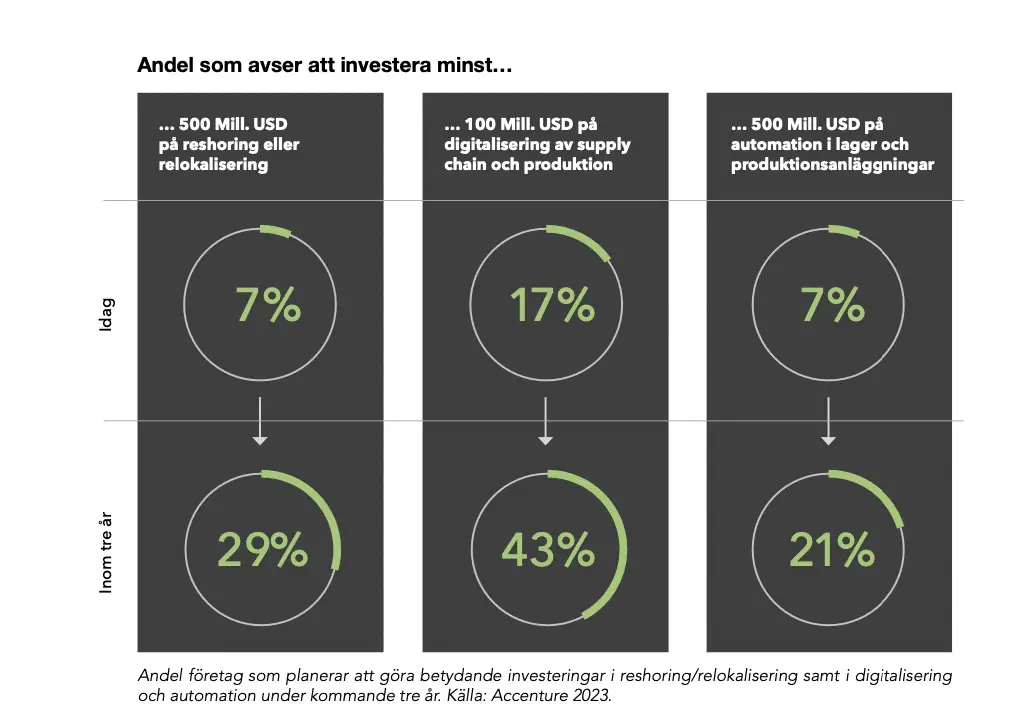
Samma utveckling pågår vad gäller handeln mellan Europa och Kina. Många europeiska företag väljer att flytta sin tillverkning från Kina till den egna hemmamarknaden eller till något annat land. Enligt Europeiska unionens handelskammare i Kina väljer nu många europeiska företag att att lämna landet på grund av en ökad pessimism vad gäller Kinas ekonomiska och demokratiska utveckling. En aktuell studie från Accenture (Resiliency in the Making, 2023) visar att 72 procent av de 1 230 tillfrågade bolagen i studien uppger att de avser att börja tillverka och sourca från flera geografiska marknader (multisourcing) under de kommande tre åren, att jämföra med att endast 42 procent av företagen gör detta idag.
Regional sourcing
Över hälften av brittiska, tyska och italienska tillverkande företag, 53, 54 respektive 53 procent, uppger att de avser att köpa merparten av sina nyckelkomponenter från regionala leverantörer senast 2026. Och hela 91 procent av franska tillverkande företag planerar att producera sina produkter i samma region där de säljs, senast om två år. Det är mer än en fördubbling av dagens situation där 44 procent av de franska tillverkande företagen producerar och säljer i samma region. Den här ambitionen finns hos alla tillverkande företag i Europa oavsett land. Accentures studie visar också att närhet till kundmarknaderna blir allt viktigare. 65 procent av de tillfrågade företagen avser att sourca och tillverka regionalt 2026, att jämföra med de 38 procent som gör det i dagsläget.
USA väljer Mexiko
USAs minskade handel med Kina har bidragit till att Mexiko under förra året blev USAs största importmarknad, samtidigt som importen från Kina föll med hela 20,3 procent. Höga tullar och geopolitiska osäkerheter bidrar till att Kina allt oftare väljs bort som tillverkningsland till förmån för Mexiko, Indien och olika länder i Sydostasien, exempelvis Vietnam, Singapore, Malaysia och Indonesien. I en färsk studie från Boston Consulting Group (BCG) lyfts Mexiko, Indien och Sydostasien fram som tre särskilt konkurrenskraftiga tillverknings- och sourcingmarknader. De har alla en attraktiv kostnadsstruktur, god tillgång till arbetskraft och en beprövad kompetens och förmåga inom en rad olika branscher.
Beredda att betala för ökad stabilitet
BCG lyfter även fram Turkiet och Marocko som exempel på andra intressanta tillverkningsländer som är konkurrenskraftiga, har gott om arbetskraft och dessutom ligger nära EUs marknader. Låga kostnader är fortsatt en avgörande drivkraft för var företag väljer att tillverka och sourca, men BCGs studie visar att korta ledtider, stabila affärsmiljöer och en ökad flexibilitet och resiliens även är viktiga parametrar. De tillfrågade beslutsfattarna i undersökningen uppgav att de var villiga att minska sina bruttomarginaler med mer än 2 procent för att få kortare ledtider och en garanterad tillgång till arbetskraft. De var även villiga att betala mer för att få en bättre stabilitet och en väl fungerande logistisk infrastruktur.
Minskad risk och ökad resiliens
Alla dessa exempel ger en tydlig indikation av hur världens handelsmönster omformas med målet att bygga mer robusta supply chains. Efter flera år av tilltagande störningar och leveransproblem i de globala försörjningskedjorna väljer många företag att se över och re-designa sina försörjningsnätverk – ofta med målet att etablera fler alternativa leverantörer och sourcingmarknader. En ytterligare bidragande faktor bakom beslut att flytta produktion och inköp är en ökad ovilja att göra affärer med auktoritära diktaturer som Kina och Ryssland, och i stället satsa på att göra affärer med vänligt sinnade länder som har likartade värderingar.
—
Stefan Karlöf är chefredaktör för Supply Chain Effect