
Rustas’ approximately 220,000-square-meter distribution center in Norrköping serves as the hub for the company’s logistics operations in Sweden, Norway, Finland, and Germany. It also lays the foundation for rapid Nordic expansion in an industry with tight margins.
Rusta was founded in 1986 with the idea of selling everyday home and leisure products at lower prices than established retailers. That business concept still holds true today—forty years later—and is made possible through direct purchasing from manufacturers, large volumes, and centralized logistics.
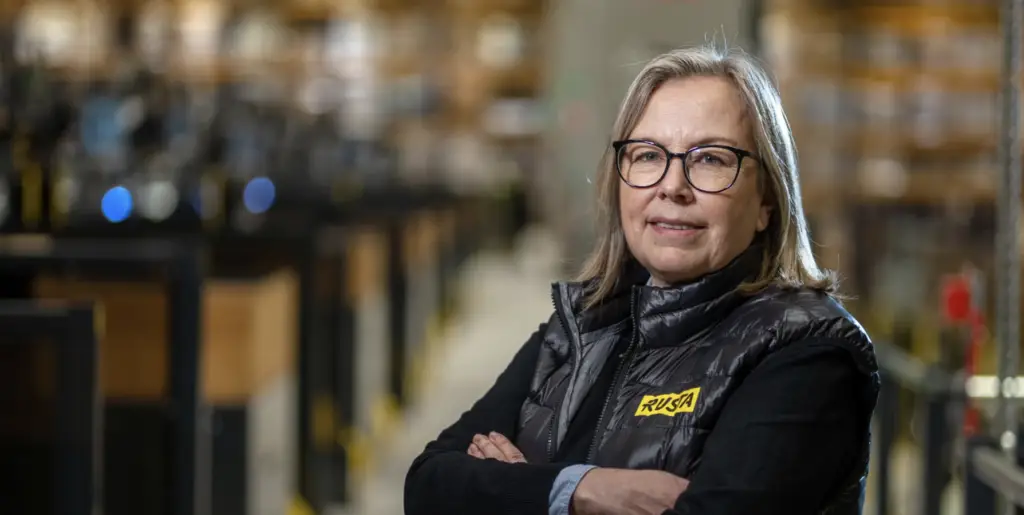
“Our vision is to become the leading and most reliable discount chain in Europe. The facility in Norrköping plays a crucial role in our expansion, since all our goods pass through there.” My job is to ensure that we keep pace with our expansion, says Eva Lindell, Head of Logistics and site manager for the logistics operations in Norrköping for nearly four years now.
Growth That Requires Business Development
And growth is happening fast. Rusta currently has 240 stores, and the plan is to open between 65 and 80 new stores, starting on May 1 of this year and continuing over the next three years. Such rapid growth not only requires more warehouse space and more advanced technology. It also requires a targeted approach to business development and employee training. Against this backdrop, Rusta has begun implementing lean principles in collaboration with its forklift supplier, Toyota Material Handling Sweden.
“We’ve been working closely with Toyota for 20 years. If you’re going to do something in the area of lean, you might as well go straight to the source—Toyota,” says Eva, explaining that it all started when she met Pär Forsell from Toyota Material Handling at a regional networking event.
“When Pär told me about their lean services, I thought, ‘This is exactly what we need right now—a little help with our lean efforts,’” she says. Minimize waste and focus on customer value The Lean method is about creating maximum value for the customer with the least possible waste. The focus is on working smarter, not more or harder, and eliminating anything that doesn’t add value. The method has its origins in the Toyota Production System (TPS) and is widely used today across all kinds of industries. The foundation of the TPS concept is to focus on flow, create stability through standardized processes and high-quality execution, and work toward continuous improvement.
– The Lean principles are simple but incredibly effective. At the same time, it should be noted that we’re more interested in the results these principles deliver. I think that’s an important distinction. Lean isn’t an end in itself,” says Pär Forsell, Senior Business Manager at Toyota Material Handling Sweden, who has extensive experience working with Lean.
Started in the receiving department
The first Lean project at Rusta was carried out in 2025 and was structured as two subprojects. One was a training program for a management group of 25–30 people, divided into four modules. The second track was a concrete kaizen project (i.e., continuous improvement) in the goods receiving area, a warehouse space that Eva describes as a part of the logistics flow that is often underprioritized.
“If anyone asks me about KPIs, lead time and picking efficiency are traditionally considered the most important. But what we do at the goods receiving area affects the rest of the flow, both in the warehouse and beyond,” she explains. Starting at the receiving department was therefore a deliberate choice. The goal was to get it right from the start and then carry those improvements through the rest of the flow throughout the facility.
Evidence-Based Change
The project began, as is customary in a Lean context, with careful observation. The team stood still and watched. They measured. They mapped out every step from unloading to quality control. They noticed that a large portion of the work was concentrated at a few stations during the morning shift, which created a heavy workload and extra work later in the process. The solution was to spread the work evenly across the entire shift and use more stations—simple in theory, but not entirely straightforward to implement in practice.
“We measure and demonstrate. That way, we work with facts, not opinions. People can disagree on many things, but they need to agree on what the measurements show,” says Pär, adding that the project faced some resistance at first.
“The resistance from the employees was understandable. They were convinced that they were working in the most efficient way possible.” “It’s when the facts are presented that the discussion changes,” he says. Eva nods in agreement and praises both the lean consultants and the managers at the freight receiving department for how the change was implemented.
– Together, we did a brilliant job of breaking this down into something the employees could get behind. The implementation is the complex part—you have to involve the staff, be persuasive, and at the same time be both humble and determined.
Investment in Skills
Eva is clear about how she views Toyota’s contribution. It is not primarily a consulting project, but rather an investment in the organization’s expertise.
“It’s an investment in us. By developing our managers’ skills, we strengthen their capabilities, which gives us a return on our investment almost immediately,” she says. Despite running at full production capacity and having ongoing construction projects, Rusta’s management team chose to participate in the training—right in the middle of the company’s peak season—and not a single person dropped out.
“Everyone was excited and thought it was fun. It’s not always easy, when the pressure is so high, to spend time on something that isn’t urgent. But they understood the value of it,” says Eva.
Major Investment in Warehouse Automation
At the distribution center in Norrköping, one of the most ambitious investments in the facility’s history is currently underway: the installation of an automated goods-to-person system right in the middle of the existing warehouse. Pär notes that lean principles and warehouse automation go hand in hand, since leveling out material flows is a prerequisite for well-functioning automation.
– Automation thrives on consistency and predictability. “If you have a peak flow, you’re forced to oversize your system, which is expensive and yields poor results. By evening out the flow at the receiving area, we created better conditions for moving forward with automation there,” he says.
The automated goods-to-person system, supplied by Vanderlande, is currently being installed and is not yet operational. As of April 1, Vanderlande’s warehouse automation business has been integrated into the newly formed Toyota Automated Logistics (TAL), alongside Bastian Solutions and viastore. In parallel with the automation project, Rusta’s regular operations continue on a two-shift schedule with an increasing flow of orders to a growing number of stores. Given the high pressure to expand, lean initiatives are vital for balancing flows, working smart, and focusing on the right things.
Continued cooperation
The Lean collaboration between Rusta and Toyota Material Handling has already taken the next step. A new kaizen project has just been launched; this time with
focus on sorting and the loading area—that is, the other end of the flow, where the goal is to find a safer and more efficient way of working.
—
Text and interview by Marika Karlöf and Stefan Karlöf






