
Developments in logistics automation are moving quickly, but alongside these technological leaps lies a more fundamental question: What role should humans play in the warehouses of the future? Automation can handle much of the repetitive and physically demanding work, but only if it functions effectively in real-world environments, where variation and unpredictability are the rule rather than the exception.
This is precisely where Rebl Industries has chosen to position itself. The company, which has been working to develop its AI- and robot-based service since 2018, has entered into comprehensive framework agreements over the past year with both H&M and IKEA —two well-known Swedish corporate icons that are already using Rebl’s robots and planning to roll them out to more locations in the future. Against this backdrop, Rebl will now scale up and industrialize its operations with the goal of establishing itself as a global leader in next-generation robotics solutions.
It all started with humans
When Rebl was founded, it all started with a workplace safety issue. The starting point was—and still is—that traditional warehouse staff will gain new robotic colleagues—colleagues who take over the tasks that people shouldn’t be doing—that is, tasks that are monotonous, strenuous, dirty, or dangerous.
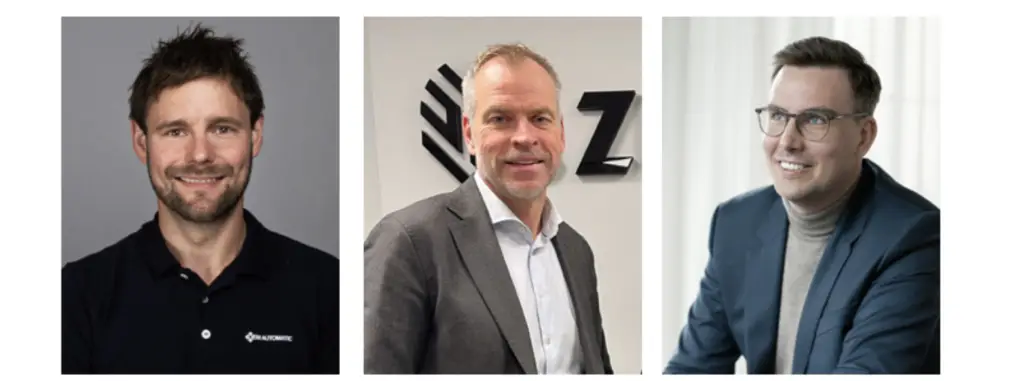
“We felt it was wrong for people to be doing things they shouldn’t be doing, especially at a time when the demands for stability, speed, and precision in logistics are increasing,” says Alexander Westerling, one of the founders of Rebl Industries and CEO of Pulsen Fusion Group, a company that has been one of Rebl Industries’ owners since 2021.
Robotics That Can Handle Chaos
The team that founded Rebl Industries had experience in both heavy industry and advanced software development. Instead of starting with conventional industrial robotics—where the environment is built statically around the machine—they chose to start at the other end.
”In an industry where ”order before automation’ has long been a fundamental principle, we wanted to build robotics that can handle the real world—rather than the other way around.” And we love chaos—situations where we can’t predict environments, goods, or sizes. That’s where our platform really shines,” says Alexander with a laugh.
These AI-powered robots have been successfully used in real-world production environments for several years. They are designed to automate tasks such as sorting, palletizing, and depalletizing to relieve warehouse workers of repetitive and physically demanding work. The robots can quickly become operational in various warehouse environments without requiring large initial investments and are offered as a performance-based service—a model that challenges many traditional automation providers.
Robots That See and Understand
What makes Rebl’s solution unique is its combination of vision and interpretation capabilities. The ability to ”see” is enabled by a vision system from Photoneo—a company acquired by Zebra Technologies in March of this year. The system is based on 3D and advanced camera and sensor technology. By collecting high-resolution 3D data on environments, objects, shapes, volumes, and contours, Rebl’s AI-based software platform can provide robots with the information and intelligence needed to act and handle a wide variety of objects at high speed, without the need to train on individual items.
– Seeing is one thing; understanding what you see is something else entirely. The platform must be able to handle situations where items aren’t categorized, where the inflow varies, and where each item might be something the system has never seen before—and our system can do just that with the help of this technology. That flexibility is essential for robotics to function within the workflows of retail and e-commerce, where variation is much greater than in traditional mass production,” explains Alexander.
Advanced cutting-edge technology
Photoneo’s cutting-edge technology—which Zebra is now further developing —is based on what’s known as parallel structured light projection, which means the sensor can create high-resolution and highly accurate 3D models even when objects are moving or when the environment is visually complex. Unlike traditional 3D cameras, these sensors can handle shiny, irregular, and textured surfaces without losing quality—a crucial advantage in warehouses where goods vary greatly in shape and material.
“With our acquisition of Photoneo, this advanced technology can be combined with our global ecosystem of software, support, and integrations, which effectively enhances performance and operational reliability for companies like Rebl,” says Mathias Lindström, Head of the Nordic Region at Zebra Technologies.
Johan Kastensson, Sales Manager for Computer Vision at OEM Automatic, agrees and emphasizes that it is the combination and integration of the 3D system and Rebl’s software platform that make the robotic solution so successful.
– What makes Rebl unique is that they actually deliver on their promises. Customers can bring their own goods to the lab, and the robots pick them right away. That’s unusual, and it’s the combination of just the right “eyes” and the right “brain” that has made it possible to bring together two worlds that have traditionally been separate, thereby capturing data within the complex logistics flows of the real world, he says, noting that OEM Automatic has supplied and implemented both the 3D system and Zebra’s scanning and RFID technologies in the robotic solution.
Picking at H&M's Nordic Warehouse
H&M’s Nordic warehouse in Borås, where over 250,000 items are stored, is one of the clearest examples of how Rebl’s philosophy is put into practice. Items picked manually in the warehouse are placed on carts, scanned, and then loaded into an automatic sorting machine. The final step, which was previously handled manually, is one of the most labor-intensive and monotonous tasks. That is why Rebl’s robots are now in operation, picking between 800 and 1,200 items per hour at full capacity. In practice, this means that at every moment of the picking process, the robots create a precise understanding of the item’s shape, position, and orientation.
“I haven’t seen anyone else come close to the performance our robots deliver. Our system can pick over 15,000 items per unit per day—a performance we’re obviously very proud of,” says Alexander.
The solution, which has been fully operational since the summer of 2024, has now begun to be used in more warehouses and in more countries.
”It’s like hiring a substitute teacher”
Rebl views the fact that the solution is delivered as a service as a model that is crucial to its success. With the service model, customers don’t need to invest in hardware, licenses, maintenance, or robots—they simply purchase a service that performs a specific task—a function.
“It should be as easy as hiring a substitute teacher. We take responsibility for the results. The customer shouldn’t have to worry about how we get it done—just that the task gets done,” says Alexander.
For Rebl, this means that revenue is generated when the robots perform, which Alexander believes creates pressure to deliver stability, support, and continuous improvement. The service model also requires that every technical component be reliable. Here, Zebra’s 3D sensors have become a central part of Rebl’s ability to deliver high performance in service delivery, as the sensors are designed for industrial environments, where they can handle vibrations, varying lighting conditions, and fast-moving flows.
– Our business model is more like a staffing model than a traditional automation project, but with robots as the workforce. And as more installations are made, the system learns collectively. Each robot feeds insights back to the platform, which in turn improves the entire fleet, Alexander explains.
Colleagues of the warehouse staff
An important aspect of the service is that the automation solutions do not need to be separated from warehouse staff. In many of their installations, there are no cages or fences separating the robots from people. The robots adjust their speed and movement based on the presence of staff, making it possible to work closely together without having to demarcate zones in the traditional way.
“We want our robots to be seen as colleagues and helpful partners, not as machines that are kept isolated,” Alexander emphasizes.
—
Interview and text by Marika Karlöf






