
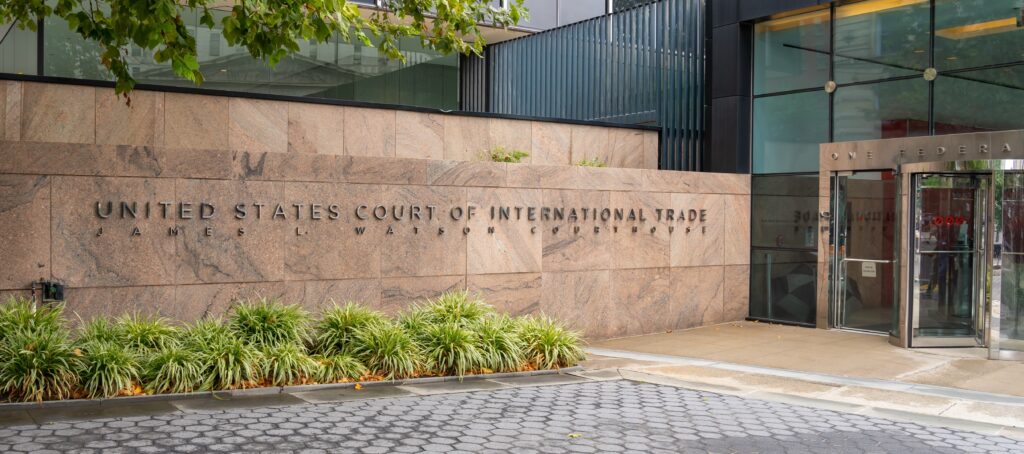
When the U.S. Supreme Court struck down Donald Trump’s tariffs in February, the U.S. administration responded by imposing new tariffs on top of the old ones. Now, however, the U.S. Court of International Trade has ruled that President Trump and his administration did not have the authority to impose new global tariffs following the Supreme Court’s decision in February.
Last Thursday, the U.S. Court of International Trade ruled Court of International Trade, invalidating Donald Trump’s attempt to impose a new 10 percent tariff on goods from virtually every country by invoking Section 122 of the U.S. Trade Act of 1974. In a 2-to-1 ruling, the court found that the president’s broad 10 percent tariff does not meet the criteria set forth in the Trade Act for when import surcharges are permitted. In a court opinion, the court found that the proclamation Trump signed to impose the tariff is invalid and that the tariffs themselves are unlawful, and that the administration’s own interpretation of the law is overly ”broad.” The immediate impact of the ruling may prove limited, as the additional 10 percent tariff expires in July, and the administration intends to impose other tariffs thereafter.
Refunds have begun
Refunds of the customs duties previously ruled unlawful by the U.S. Supreme Court have now begun to be issued, even though the bureaucratic process is extensive and resistance to the refunds is widespread within the administration. Despite this, the unlawful customs duties—which amount to nearly $166 billion—have slowly begun to be refunded to the importing companies, and thus, ultimately, and in some cases, to the selling companies as well.
Importer's Liability
In a strictly technical sense, it is the original ”customs broker,” the registered importer, who must apply for a refund of the unauthorized customs duties, since the duties have been paid to U.S. Customs and Border Protection (CBP) by importing U.S. companies. These companies are now entitled to request and receive a refund through a system explicitly designed so that it is the importer who must apply for and receive the refund into their account. Subsequently, the selling/exporting company—for example, a Swedish company—may request reimbursement from the importer in cases where it has lowered its price to compensate the importer for the duties and in other cases where the seller has, in practice, borne the cost of the duties. However, this is a purely commercial and contractual matter between the parties and is not affected by that legislation.






